
About All Tours Safari ToursConservation Area ToursLuxury Safari ToursCrater & Serengeti ToursPrivate Tours Directions Hours & Fees Guides
Find Tours 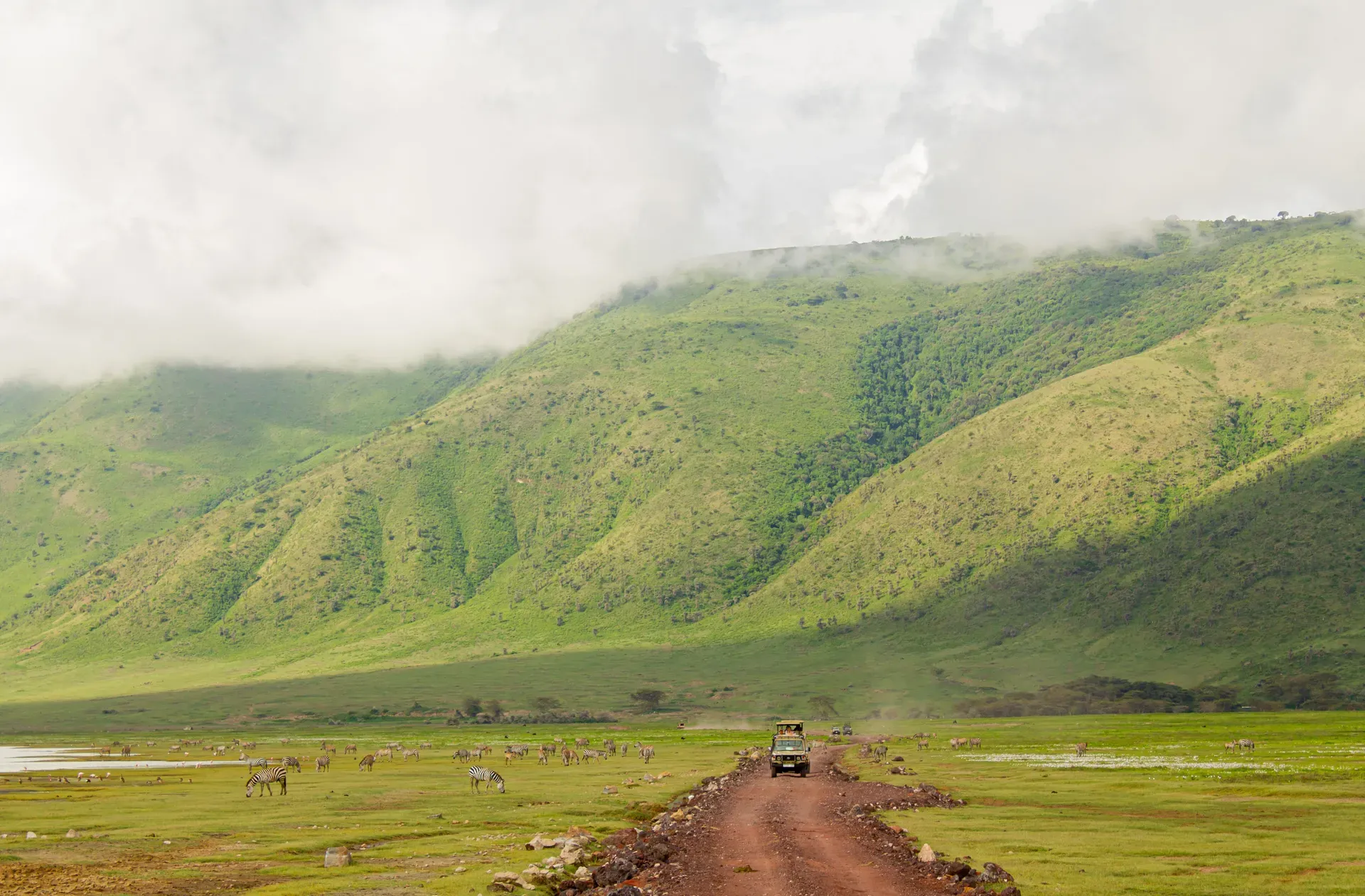
Two and a half million years ago a giant volcano in northern Tanzania collapsed and left a 16-19 km bowl that now holds some 25,000 large animals — including Africa's densest lion population and a precious black-rhino herd.
About 2.5 million years ago a giant volcano in northern Tanzania emptied its magma chamber and collapsed in on itself. What survived is the largest intact, unbroken caldera on Earth: Ngorongoro Crater, 16-19 km across, with walls 400-610 m high and a rim topping out near 2,300 m. It sits 180 km west of Arusha at the heart of the 8,292 km² Ngorongoro Conservation Area, and its 260 km² floor — grassland, acacia forest, swamp and a shallow soda lake — feeds around 25,000 large animals year-round.
In practice, that means a half-day game drive on a compact road network where sightings come fast. Lion, elephant, buffalo and hippo can appear within a few hundred metres of each other. The crater holds the densest known lion population in Africa, leopards work the Lerai Forest, and one of Tanzania's few viable black-rhino populations lives on the slopes. Because Lake Makat, the Gorigor Swamp and Ngoitokitok Spring keep water on the floor permanently, the animals stay resident — you don't spend hours searching the way you can in the Serengeti.
UNESCO listed the area in 1979 for its natural values and extended the listing in 2010 to cover culture, largely because of Olduvai Gorge, where the deposits span 2.1 million years of human ancestry. Semi-nomadic Maasai herders still live and graze cattle inside the reserve under a 'multiple land use' model that remains rare in African conservation. Some 752,232 people visited in 2023. Gates open at 06:00 — be there, because the first three hours give you the best light and the most active predators.
The crater began as a volcano roughly 2.5 million years ago. When the magma beneath it drained away, the mountain caved into the void, leaving a bowl 17.7 km by 21 km with a 26,400-hectare floor — just 3% of the wider conservation area. The Maasai named it long before any surveyor arrived: 'Ngorongoro' imitates the sound of a cowbell. That name tells you who was here first, and who is still here.
People have lived around this caldera far longer than any park boundary. Olduvai Gorge, a 14-km ravine about 90 m deep on the western approach, holds deposits spanning 2.1 million to 15,000 years ago. In 1911 the German butterfly collector Wilhelm Kattwinkel became the first European to record the gorge, and Louis Leakey began excavations there in 1931. Then came July 1959, when Mary Leakey pulled a 1.75-million-year-old skull — Zinjanthropus boisei, the 'Nutcracker Man' — out of the deposits and made the gorge the most famous site in paleoanthropology. At Laetoli, 45 km away, hominid footprints preserved in volcanic ash since 3.6 million years ago were uncovered in 1972, among the earliest evidence anywhere of upright walking.
1959 was a double milestone. In the same year as the Zinjanthropus find, the Ngorongoro Conservation Area Ordinance carved the NCA out of the newly gazetted Serengeti National Park, so that Maasai herders displaced by the park could keep living alongside wildlife. That 'multiple land use' arrangement was new to Africa and still is.
UNESCO inscribed the NCA on the World Heritage List in 1979 for its natural values; it spent 1984-1989 on the Danger List, joined the Serengeti as a Biosphere Reserve in 1981, and was re-inscribed as a mixed cultural-natural site in 2010. The Ngorongoro Conservation Area Authority now runs it, and 752,232 tourists came in 2023. The crater tour is officially a half-day activity and permits cover one entry. Fees were set in July 2021 — US$70.80 per adult per 24 hours, plus US$295 per vehicle to descend — but they can rise each 1 July with short notice, so confirm current rates with your operator before you travel.
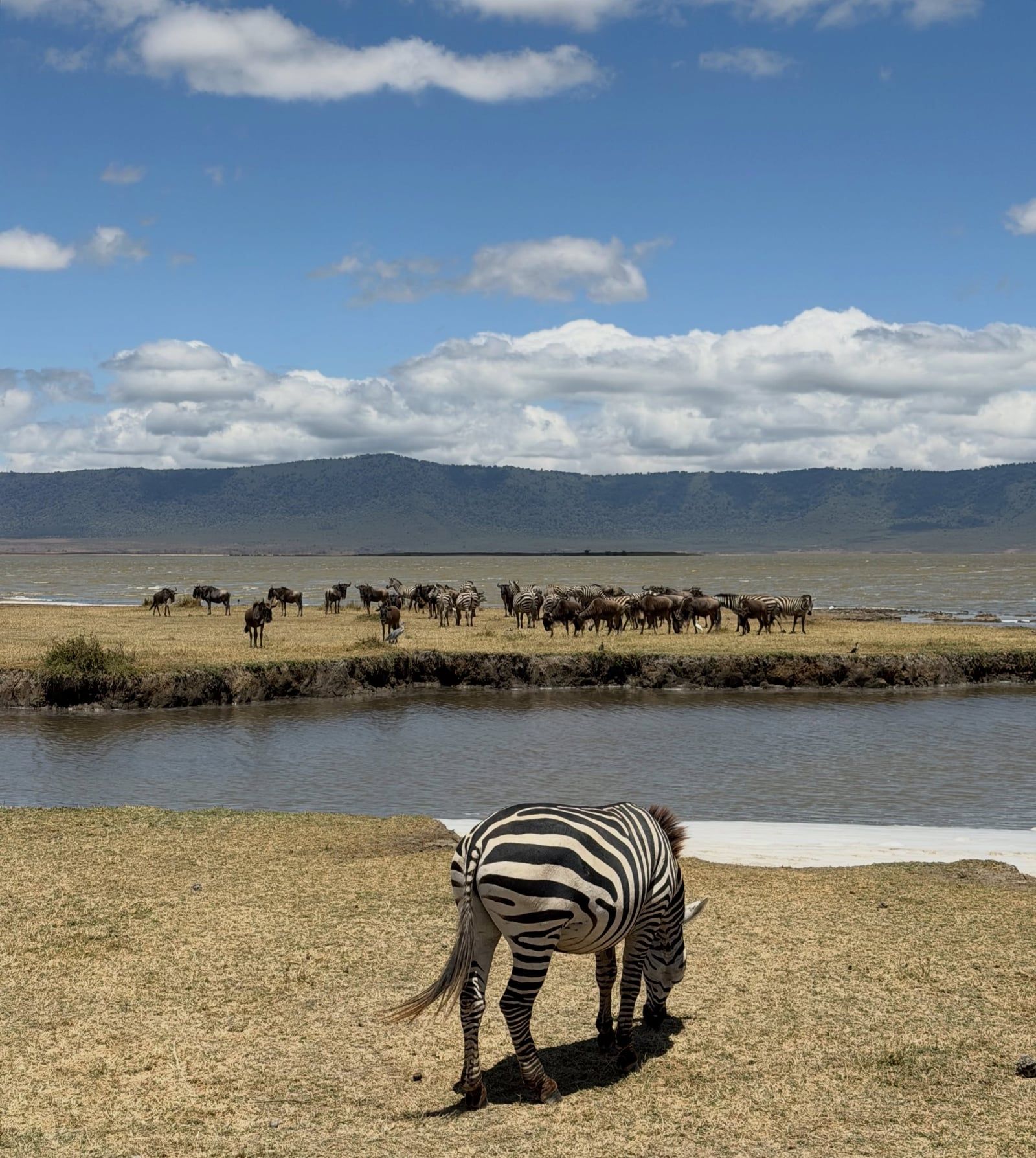
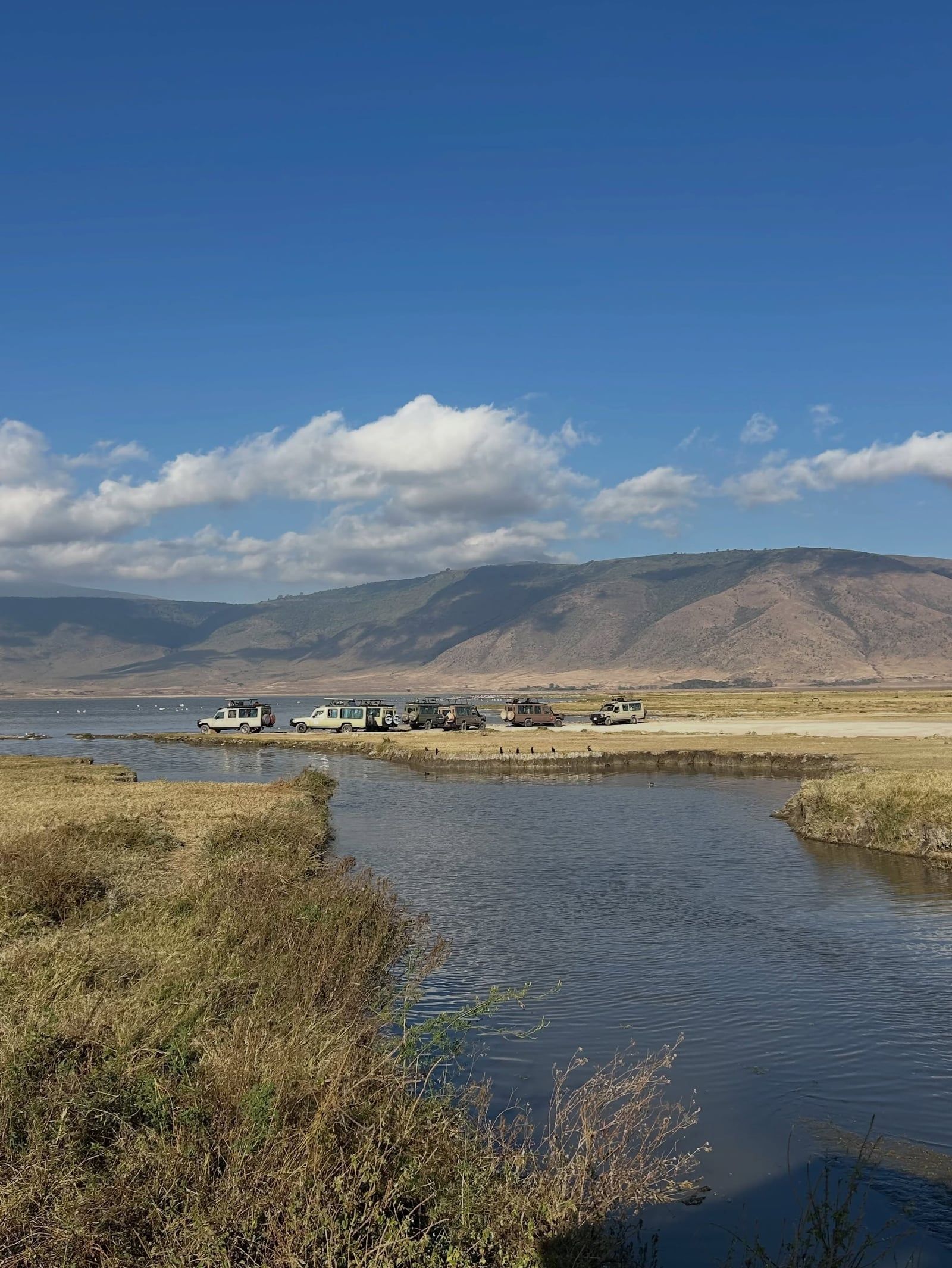
The caldera measures 17.7 × 21 km, and the rim sits at roughly 2,200-2,300 m — high enough that mist regularly pours over the edge and pools on the floor at dawn. The floor lies 400-610 m below, a mosaic of short grassland, the Lerai Forest, the reedy Gorigor Swamp and shallow, alkaline Lake Makat. Flamingos settle on the lake when water levels suit; hippos loaf in the swamp, which is also a favourite ambush spot for lions. Rain that falls on the rim drains inward, which is why the bowl never dries out and the wildlife never has to leave.
Getting down is half the experience. The Seneto descent road switchbacks about 600 m through wet montane forest in roughly half an hour — buffaloes and baboons frequent the lower bends — before the trees open onto grassland all the way to the horizon. Seneto handles descents only, Lerai ascents only, and Lemala (Sopa) both directions; all three are 4x4-only and can turn to mud in the long rains.
The crater gets the fame, but it's a small piece of the property. The conservation area climbs from 1,300 m to 3,300 m across the Crater Highlands, with four extinct volcanic peaks above 3,000 m, including Loolmalasin. Neighbouring Olmoti and Empakaai craters — Empakaai with its own deep soda lake full of flamingos — plus Olduvai Gorge and Lake Ndutu complete the mix of short-grass plains, montane forest, savanna woodland and high moorland. If you have two days, give one to the crater and one to Empakaai or Olduvai. You'll share them with a fraction of the vehicles.
To the Maasai, this is working land. Herders live inside the conservation area and graze cattle across the highlands alongside wildebeest and zebra, a coexistence the 1959 ordinance deliberately protected when they were pushed out of the Serengeti. It remains one of very few African protected areas where people are allowed to stay, and the arrangement is what earned the site its 2010 cultural listing alongside the natural one. The name itself — a Maasai imitation of a cowbell — puts livestock at the centre of the place.
There's a second meaning here, and it's global. Olduvai Gorge and the Laetoli footprints give this stretch of the Rift Valley one of the longest records of human evolution anywhere on Earth, from 3.6-million-year-old footprints to the Zinjanthropus skull. Tanzanians call the region the Cradle of Mankind, and the museum at Olduvai displays casts of the Laetoli trackways — roughly 27 m of Australopithecus afarensis footprints — for anyone who wants to stand in front of the oldest footsteps we have.
Visitors can meet Maasai communities near the rim road: village visits typically include traditional dances, homestead tours and craft markets. Bring small US dollar bills, since these stops run on cash, and cover shoulders and knees when you go. Always ask before photographing anyone — it's both courtesy and local expectation.
The crater floor holds the densest known lion population in Africa. The prides are resident, so guides know roughly where to find them on any given morning.
One of Tanzania's few viable black-rhino populations lives on the crater slopes. In the dry season's short grass, guides routinely find rhino, lion and cheetah within a few hundred metres of each other.
Around 500 bird species have been recorded in the conservation area. Migratory birds pass through between January and February, when the plains are green.
Nights on the rim drop to 0-5°C, and mist can shroud it even in daytime. Many lodges have no heating beyond a fireplace, so pack a fleece.
NCAA rules require every vehicle entering the crater to carry a heavy-duty jack, chain or rope, a shovel and an axe. Track conditions demand it.
Tanzania banned plastic carrier bags nationwide on 1 June 2019, and airports inspect luggage. Resealable 100 ml liquid bags are the one tolerated exception.
The famous crater floor covers just 26,400 hectares — about 3% of the conservation area. Olmoti, Empakaai, Olduvai Gorge and Lake Ndutu fill the rest, with a fraction of the crowds.
Around 2.5 million years ago, a giant volcano's magma chamber drained and the mountain collapsed into the empty space beneath it. The result is a caldera 16-19 km across with walls 400-610 m high — the largest intact, unbroken caldera on Earth. Unlike most craters, it never filled with water; instead the floor supports grassland, forest, swamp and a shallow soda lake.
Foreign non-residents pay US$70.80 per adult per 24 hours (US$60 plus 18% VAT) and US$23.60 per child aged 5-15; under-5s enter free. Descending into the crater adds a US$295 crater service fee per vehicle, so a couple sharing one 4x4 pays roughly US$437 in fees for one descent plus a day's entry. Camping starts at US$35.40 per adult per night on public sites.
Yes. It's 180 km and 3.5-4.5 hours each way, so day tours leave Arusha around 05:00-06:00. NCAA's official schedule states the crater tour is a half day and permits are valid for one entry, so most day-trippers descend by 08:00 and exit by early afternoon. Overnighting on the rim or in Karatu makes for a far more relaxed visit.
Gates open at 06:00 and close at 18:00 daily, year-round, and game drives inside the crater are only permitted between those hours. The Seneto Descent Gate closes earlier, at 16:00. Arrive early — the best light and most active predators come in the first three hours.
The crater packs all of the Big Five plus about 25,000 large animals into a 260 km² bowl, so sightings are near-guaranteed even on a half-day drive. The Serengeti instead rewards multi-day visits. Entry fees are similar for both parks, but Ngorongoro adds the US$295-per-vehicle descent fee, which makes it best suited to one focused game drive.
A licensed guide is mandatory for the crater and Olduvai Gorge, and the descent roads are 4x4-only — two-wheel-drive vehicles are unsuitable and tracks can be impassable in the rains. Self-drive is technically possible with your own vehicle plus a mandatory guide, but nearly all visitors charter a 4x4 with a driver-guide from Arusha, Moshi or Karatu.
Yes, malaria is present in the area even at altitude, so take prophylaxis and use 20-35% DEET repellent, long sleeves at dusk and permethrin-treated clothing. Tsetse flies also bite in the woodlands; avoid dark blue and black clothing, which attracts them.
Colder than most people expect. The rim sits at about 2,200-2,300 m, with nights often 0-5°C and cold mist even in daytime, while the floor 600 m below warms up quickly. Dress in three layers — base, fleece, windbreaker — because lodges often have no heating beyond a fireplace.
Rim lodges put you minutes from the descent gates so you can be among the first vehicles down at 06:00, but they're pricier and cold at night. Karatu, the farming town outside the NCA, is cheaper and about an hour from the gate. Many travelers combine one rim night with Karatu nights.
No. Visitors must remain inside the vehicle on the crater floor except at designated picnic sites such as Ngoitokitok Springs. Walking is only possible on licensed walking safaris outside the crater, on the rim and in the Highlands, which cost US$23.60 per adult with a maximum of 8 walkers per guide.
Browse verified tours with free cancellation and instant confirmation.
Find Tours