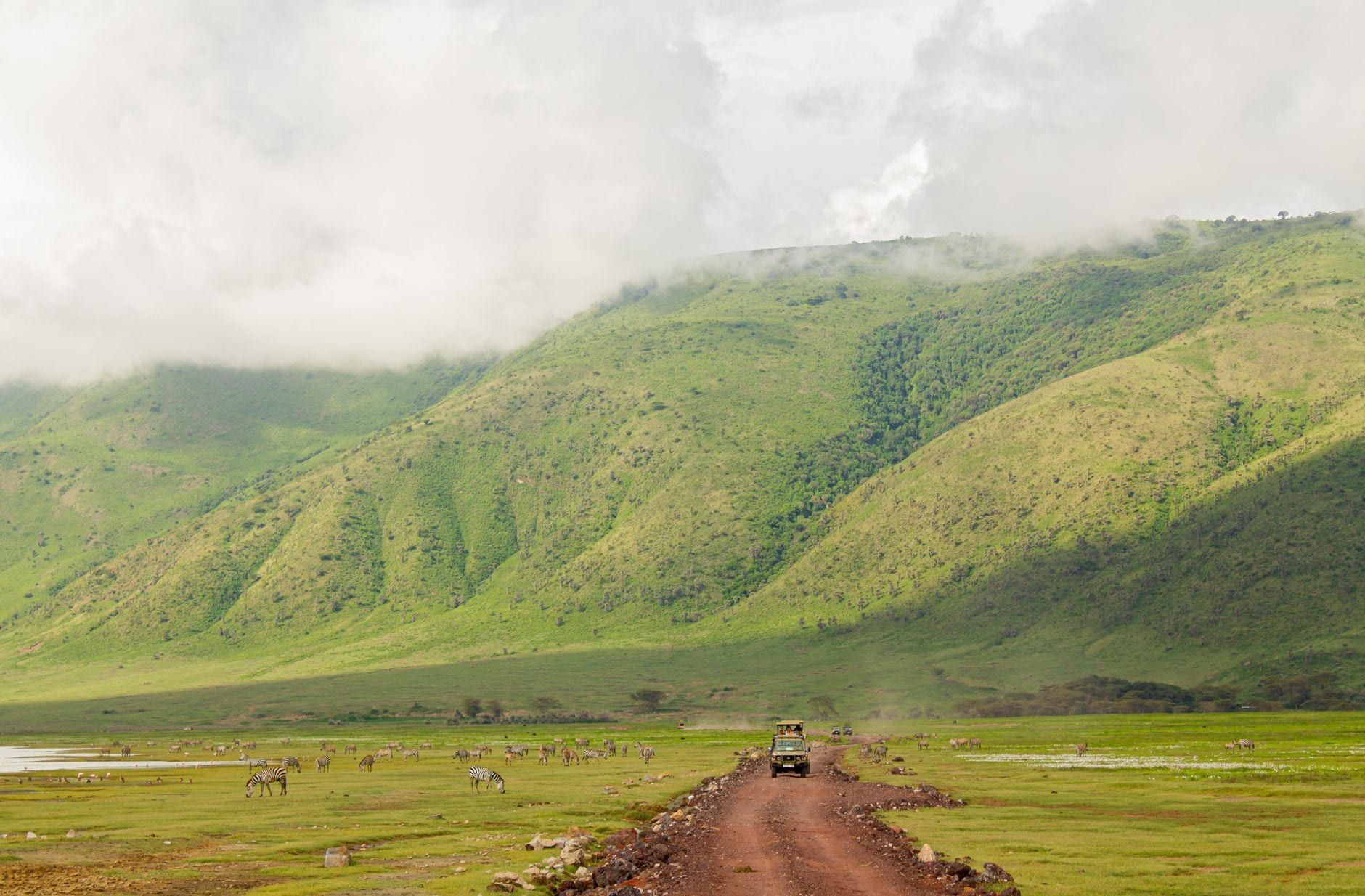
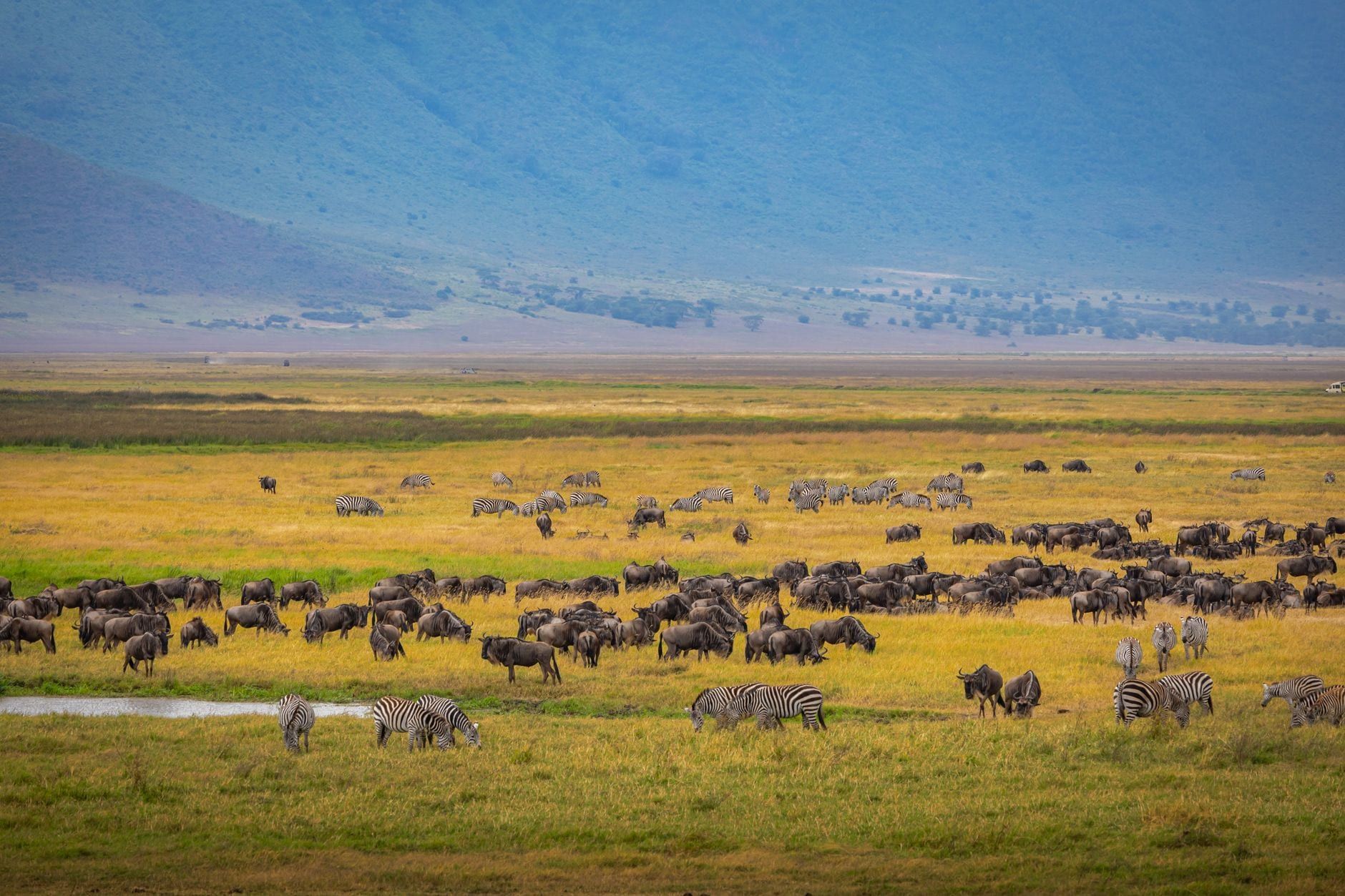
Ngorongoro Crater squeezes an entire safari into a single morning. The floor of this collapsed volcano holds roughly 25,000 large animals — lions, elephants, buffalo, and one of Tanzania's last black rhino populations — inside a 260 km² bowl you can drive across in a day. There is nowhere else on the continent where the odds stack up like this, which is exactly why a Ngorongoro Crater safari is the most expensive single day in Tanzanian tourism and why the queue at the descent gate starts before sunrise.
This guide covers what the day actually involves, what you'll realistically see, what it costs, where to sleep, and how the crater fits into a Northern Circuit trip. If you're comparing operators, our crater safari tours page lists the current options.
What Is the Ngorongoro Crater — and Why It's Different From Every Other Safari
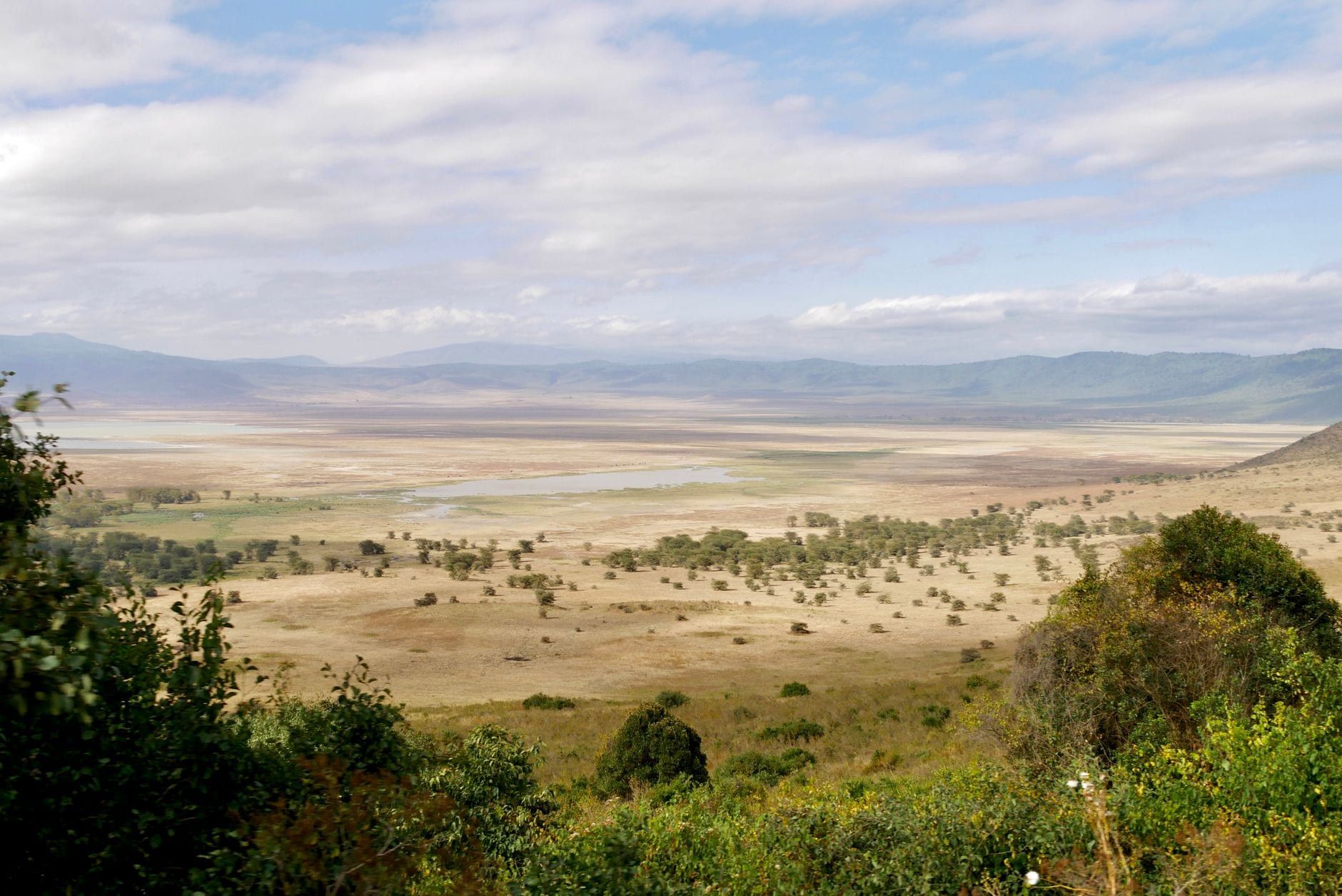
Ngorongoro is the world's largest intact volcanic caldera: 16-19 km across, with a 260 km² floor sitting roughly 600 m below a rim at 2,200-2,300 m. About 2.5 million years ago a volcano that may have rivalled Kilimanjaro collapsed in on itself, leaving an unbroken bowl. Visitors call it a crater; geologists call it a caldera, and the distinction matters — an impact or explosion crater scatters its walls, while a collapsed caldera keeps them, and those walls are why the wildlife is trapped in concentrate.
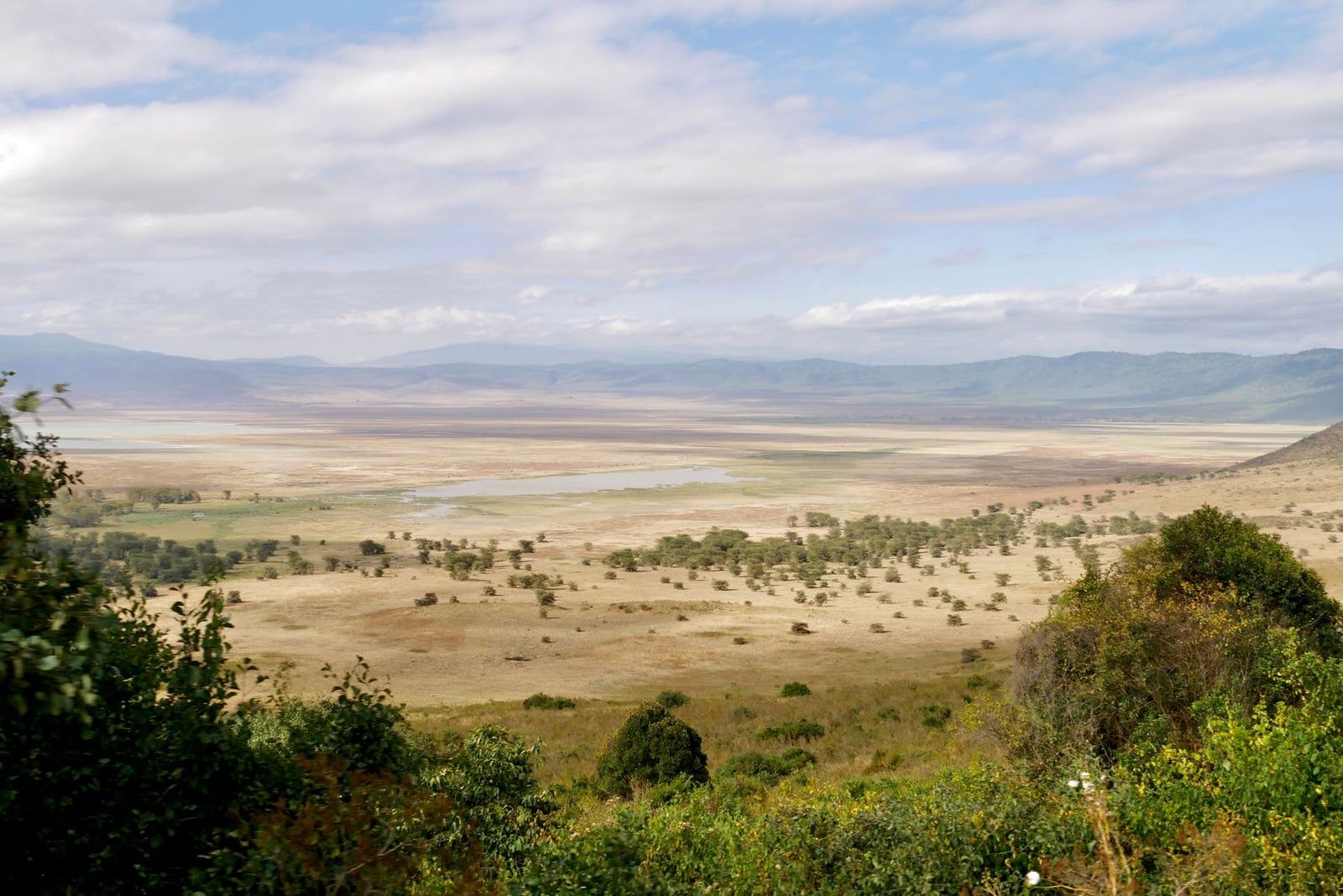
The crater is just 3% of the Ngorongoro Conservation Area, an 8,292 km² stretch of highlands between the Serengeti plains and the Rift Valley, established in 1959 and inscribed by UNESCO in 1979 (its cultural values were added in 2010). It is the only protected area in Tanzania where Maasai pastoralists live and graze cattle alongside wildlife — a deliberate split from the Serengeti National Park next door, which was gazetted the same year without its herders. You'll see cattle and red shuka cloth on the rim roads; you won't see them on the crater floor.
Because the walls are too steep for the herds to leave, the animals are resident. The floor holds permanent water in Lake Magadi and the Gorigor Swamp, so there is no migration out and no bad month for sightings — the opposite of the Serengeti, where timing is everything. That density is the product. The trade-offs:
- Near-guaranteed Big-Four sightings and black rhinos in one morning.
- One of Africa's densest lion populations and 500+ bird species.
- Heavy vehicle traffic — 27-50 jeeps cluster at prime sightings in peak season.
- The highest fees of any Tanzanian park day, plus a half-day time limit.
Which Animals You'll See (and Which You Won't)
Plan on lion, elephant, buffalo and black rhino in a single morning; leopard is the Big Five holdout. The crater holds 60+ lions — around 21 per 100 km², one of the densest populations in Africa — and their isolation has produced noticeably darker, heavier manes. You'll find them sprawled on the eastern plains or lurking near the Gorigor Swamp, which is a favourite ambush spot. About 6,000 spotted hyenas share the floor with them.
Black rhinos are the headline. Roughly 30 remain, down from about 100 in the 1960s, and each is monitored around the clock by rangers with tracking devices. Your best chance is the first two hours after the gates open, in the open ground between Lerai Forest and Gorigor Swamp — another argument for the early start. Bring binoculars; rhino often feed on the far slopes where vehicles can't follow.
Elephants here are almost all old solitary bulls, some of them genuine big tuskers, most often browsing in Lerai Forest — the breeding herds stay up in the highlands. Around them graze the resident herds: about 7,000 wildebeest, 4,000 zebra, 4,000 buffalo, plus eland and gazelle, all adding up to the 25,000 large animals the floor supports year-round. Our full animal guide goes deeper on each species.
| Animal | Likelihood | Best spot and time |
|---|---|---|
| Lion | Very likely | Eastern plains and swamp edges, early morning |
| Elephant | Very likely | Lerai Forest, any hour |
| Buffalo | Very likely | Herds across the open floor, all day |
| Black rhino | Good chance | Lerai–Gorigor open ground, first two hours |
| Leopard | Rare | Lerai Forest, early morning |
| Wildebeest and zebra | Certain | Floor-wide, all day |
Two absences surprise people. There are no giraffes — the walls are too steep to descend and the floor lacks the open woodland they feed in — and no crocodiles. Both are common in the wider conservation area and the Serengeti. Cheetah, African wild dog, serval and golden cat turn up only occasionally; a serval in the long grass is a genuine bonus, not a planning assumption.
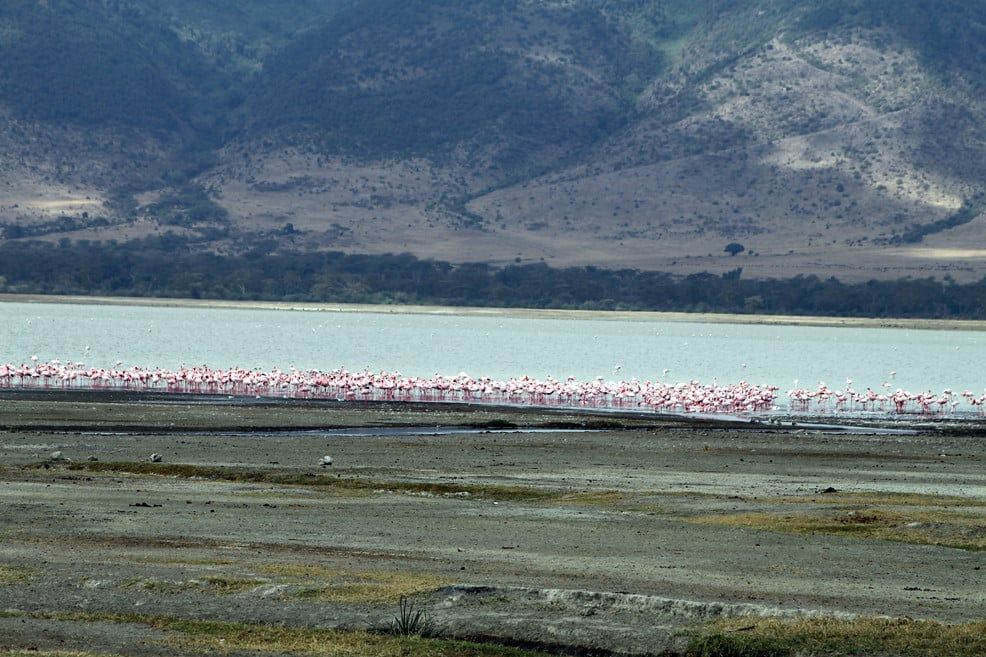
Birders get more than 500 species across the crater and rim forests, and the shallow soda lake at the crater's heart draws flamingos when water levels suit. November to April is the peak, when migratory species arrive. If that's your angle, budget a full morning rather than a rush past.
What a Crater Safari Is Actually Like, Hour by Hour
The whole experience is one half-day game drive, and the timeline is fixed by the gate schedule: gates open at 6:00 am, the crater closes at 6:00 pm, and the Seneto descent gate stops admitting vehicles at 4:00 pm. Seneto is descent-only; you climb back out on the Lerai ascent road or the two-way Lemala road. Here is the day as it should run:
- 5:30 am — wake at a rim lodge; tea, then to the gate for opening.
- 6:00-6:30 — descend Seneto, dropping 600 m through montane forest.
- 6:30-8:30 — best light; predators and rhino still active on the plains.
- Mid-morning — Lerai Forest for elephants, then Lake Magadi for flamingos.
- Midday — Gorigor Swamp for rhino and hippo, then the Ngoitokitok picnic.
- Early afternoon — eastern plains for lions before the ascent road.
- By 4:00-5:00 — out of the crater; all vehicles must exit by 6:00 pm.
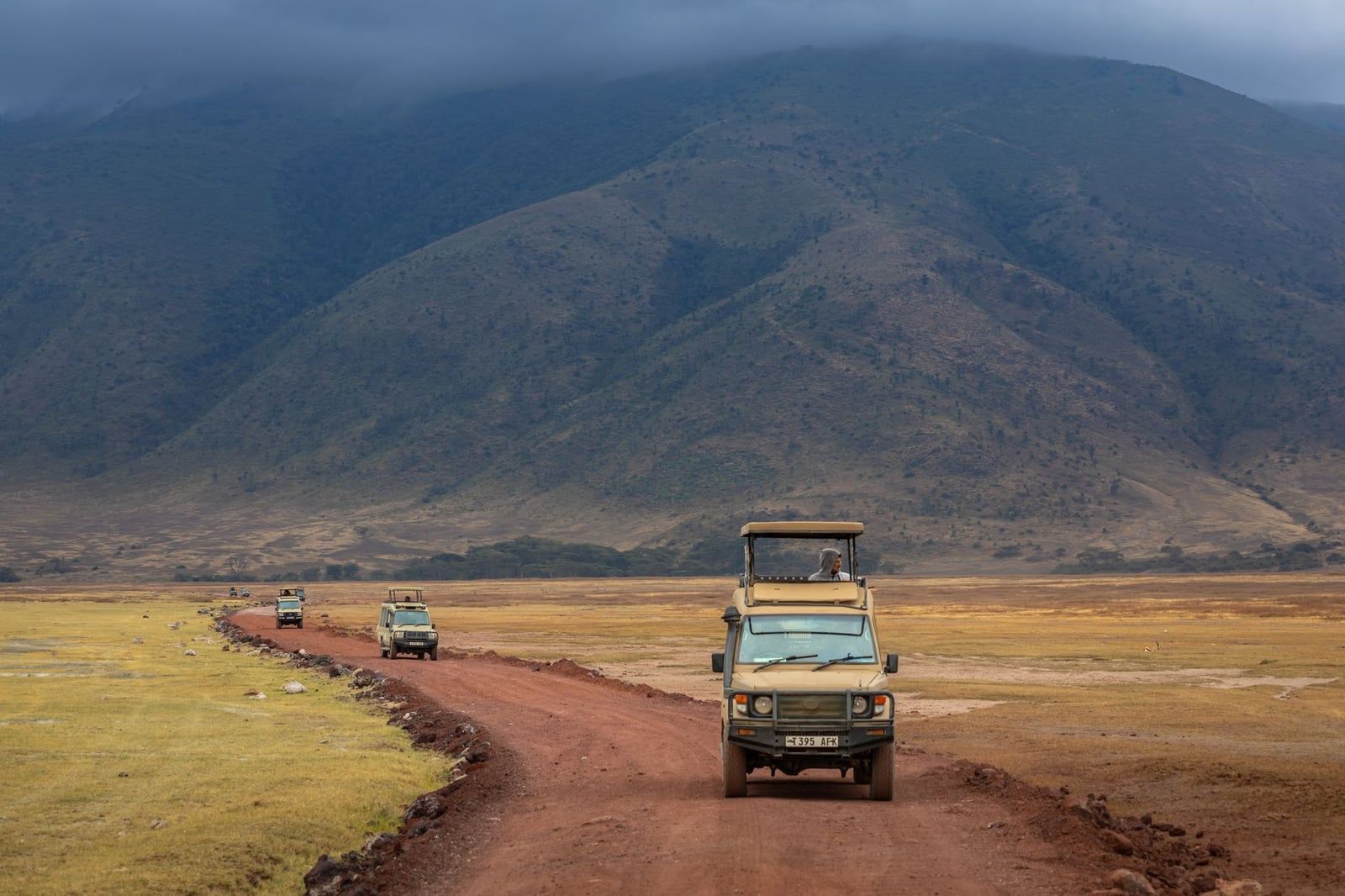
The descent itself takes about 30 minutes of switchbacks, with buffalo and baboons on the lower bends before the forest opens onto grassland — the moment most people remember. Once on the floor, you stay in the vehicle: the speed limit is 25 km/h, off-roading is banned, and walking safaris don't exist down here. A licensed guide is mandatory, and your guide's radio intel on sightings is half the value of a guided vehicle.
Ngoitokitok Spring, beside a hippo pool, is the classic lunch stop and one of the only places you may step out. Guard your food — black kites swoop and baboons are bolder still. Bathrooms exist only at designated picnic sites, so plan accordingly.
Now the honest part. NCAA's rule says no more than five vehicles around one animal; travelers in peak season report 27-50 jeeps stacked at a lion or rhino sighting. It can feel more like a managed viewing than a wilderness. The fixes: be first down the Seneto road, let your guide work the quieter eastern side while the crowd mobs the west, or take the afternoon-descent option covered below. Go in expecting crowds and the density still wins.
How Much a Ngorongoro Crater Safari Costs — and Whether It's Worth It
Three fees stack on a crater day: the conservation-area entry, the per-vehicle descent fee, and — if you sleep on the rim — a concession charge. Current figures, with the caveat that NCAA tariffs change without notice and typically rise each 1 July:
| Fee | Amount | Basis |
|---|---|---|
| NCA entry, adult (16+) | $70.80 | Per person per 24 hours |
| NCA entry, child (5-15) | $23.60 | Per child per 24 hours; under-5s free |
| Crater service fee | $295 | Per vehicle, per descent |
| Rim concession | About $59 | Per person per night on the rim |
| Public campsite | $35.40 | Per adult per night |
| Walking safari (rim/highlands) | $23.60 | Per adult, max 8 per guide |
Run the math for a couple on a day trip from Karatu: $141.60 entry plus $295 for the vehicle is roughly $437 in fees before you pay for the 4x4 and guide. Add a rim night and the concession fee lifts it to about $555. A solo traveler pays the same $295 vehicle fee alone unless joining a group — which is why shared vehicles are the budget play, cutting the descent fee to $49-74 each in a party of four to six. Full budget-to-midrange crater days, vehicle and guide included but excluding accommodation, run about $220-380 per person.
Payment is card-only at the gates; cash is no longer accepted, though tour operators normally prepay and you just show the receipt or serial number. When comparing quotes, check exactly which fees are included — the $295 is the line item that catches people out. Our official hours and fees page tracks the current rates.
Is it worth it? For most travelers, yes — this is the most expensive day in a Tanzanian safari and also the highest-yield one, with rhino odds you won't get anywhere else and density that makes a half day feel full. Just know what you're buying: a managed, time-limited drive, not an open wilderness day. A second descent costs another $295 per vehicle and is only worth it if you want different light and thinner crowds — the afternoon tactic in the next section.
Best Time to Visit Ngorongoro Crater
Any month works, because the wildlife can't leave. That's the crater's structural advantage over the Serengeti, and it should shape your planning: pick your dates for crowds, price and weather, not for animals. The best time to visit breaks down into four windows.
June to October, the long dry season, is the prime window: short grass, animals concentrated around permanent water, and the easiest rhino and big-cat spotting. It's also peak crowds and peak prices — July through September is when those 30-vehicle clusters happen. January-February is the smart alternative: green scenery, newborn animals, migratory birds and noticeably fewer vehicles, and it coincides with the wildebeest calving on the Ndutu plains just to the south. November to mid-March generally follows the same green-season pattern.
Mid-March to mid-May, the long rains, is the difficult stretch — downpours turn the descent and highland tracks to mud, and mist can swallow the rim. The payoffs are rates 30-50% below peak, near-empty roads and vivid green grass that makes rhino easier to spot in the open. Bring patience and a flexible schedule if you try it.
One clarification that trips people up: the famous calving spectacle happens on the Ndutu Plains at the NCA/Serengeti border from January to March, not on the crater floor. If you're travelling then, pair a crater day with two Ndutu days — that's the strongest January-February itinerary there is. Whenever you go, pack for the rim: nights sit at 0-5°C all year at 2,300 m, while afternoons on the floor run warm and windy.
Where to Stay: Crater Rim vs Karatu
This is the decision that shapes your morning. Rim lodges sit minutes from the descent gates, so you're on the floor by about 6:30 am — typically 45-60 minutes ahead of the vehicles driving up from Karatu, and squarely inside the 6:30-8:30 window when predators are active and the light is best. You also wake up inside the caldera view itself. The costs are real: a $59-per-person-per-night concession fee on top of the rates, limited and pricier lodges (Ngorongoro Serena runs roughly $155-500 per person per night as a benchmark), and nights cold enough that you'll want the fireplace lit.
Karatu, the farming town outside the gate, is roughly an hour's drive away and much cheaper, with a wide run of mid-range and boutique options — coffee-farm lodges are the local speciality — and the budget-rational choice if you don't mind a pre-dawn departure. Many travellers split it: one rim night before the descent, Karatu nights either side. Our lodge guide compares the specific properties.
The middle path is camping on the rim at a public site like Simba A — about $35.40 per person, no advance booking needed for the public sites, and the same 6:00 am head start the lodges get, minus the heating. Pack for 0-5°C nights.
One tactic most guides never mention: the double descent. Arrive midday, descend late afternoon when the tour buses have thinned, then go down again at dawn the next morning. You get two kinds of light and half the crowds — but you pay the $295 vehicle fee twice. Worth it for photographers and anyone on a relaxed schedule; skip it if the budget is tight.
Getting There, Self-Drive vs Guided, and How Many Days You Need
The crater lies about 180 km west of Arusha — 3.5-4.5 hours by road, tar for the first stretch, then gravel up the Rift Valley wall to Loduare Gate. Mto wa Mbu is the last reliable fuel stop. Most international arrivals land at Kilimanjaro International (JRO), sleep in Arusha, and drive up the next morning as part of a Manyara-Ngorongoro-Serengeti circuit. If the drive doesn't appeal, daily light-aircraft flights from Arusha or the Serengeti land at Lake Manyara Airstrip ($150-250 one-way), which is 1-1.5 hours from the rim. Full route details are on our getting there page.
Self-drive is legal in the conservation area, but it rarely pays. The descent requires a 4x4 with recovery gear and a licensed guide, and once the mandatory $295 vehicle fee is paid, your savings over an operator are marginal — while the operator's radio network, which relays rhino and lion positions between vehicles, is worth real money in sighting terms. Unless you have your own kitted 4x4 and experience, book a guided vehicle. Vehicles entering the crater must carry a heavy-duty jack, chain or rope, shovel and axe.
How many days? One 5-6 hour drive covers the crater floor — that's the whole product, and stretching it to two descents only makes sense with the double-descent tactic or slack time. What extra nights buy you is the rest of the conservation area: Ndutu's calving plains, the Empakaai hike, Oldupai Gorge. Sample structures: a single long day from Arusha (brutal but doable); two days with a Karatu or rim overnight; three days pairing Tarangire, Ngorongoro and a Serengeti edge; five to seven for the full Northern Circuit plus a Zanzibar beach add-on. On the standard circuit, Ngorongoro usually sits between the Serengeti days and the drive back to Arusha, and combined Serengeti itineraries handle that sequencing for you.
Beyond the Crater Floor: Oldupai, Empakaai, Ndutu and Maasai Country
The crater is 3% of the conservation area; the other 8,000-odd km² hold some of Tanzania's best add-ons. Oldupai Gorge sits right on the Ngorongoro-Serengeti road, so it costs you almost no driving time. This is where Mary Leakey found the 1.75-million-year-old Zinjanthropus skull in 1959, and the museum plus a guided walk into the gorge take about 90 minutes, with casts of the 3.6-million-year-old Laetoli footprints on display. Entry for foreign visitors runs around $35, and a licensed guide is required.
Empakaai Crater, about two hours' drive northeast, is the highlands at their best: a ranger-guided hike of 1.5-4 hours down to a deep soda lake holding thousands of flamingos, with Ol Doinyo Lengai volcano on the skyline. Its quieter sibling Olmoti Crater, with the Munge waterfall, is a gentler ranger-led walk. The walking-safari fee is $23.60 per adult, capped at eight walkers per guide — details in our rundown of things to do in Ngorongoro.
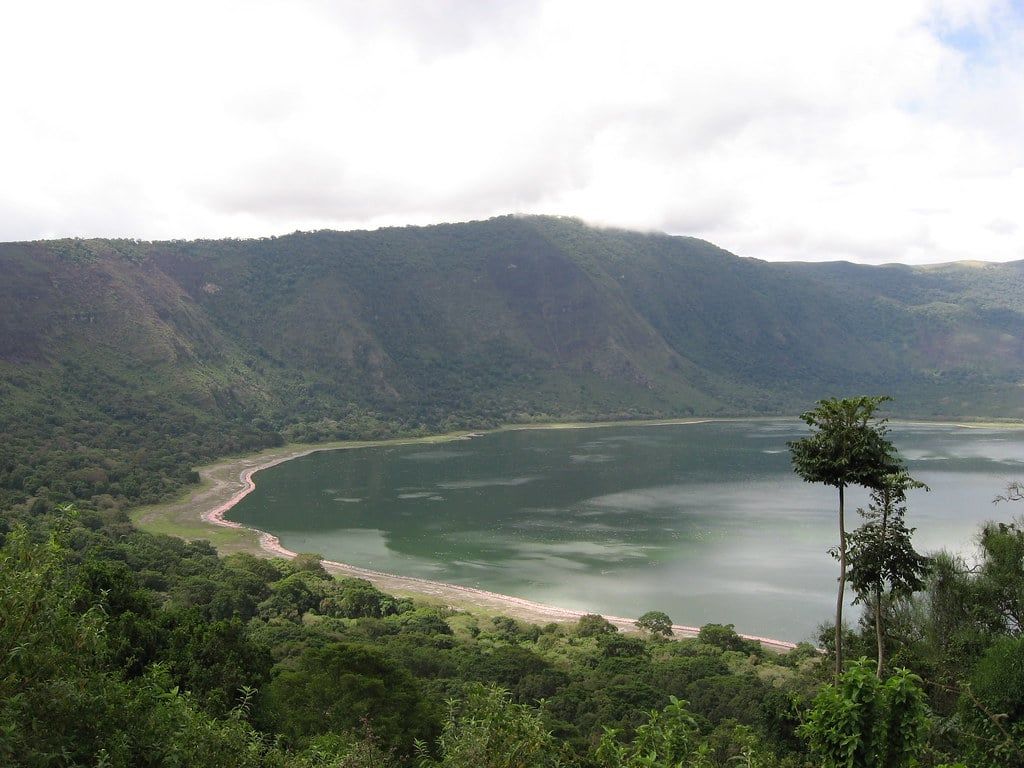
The Ndutu Plains, January to March, are the reason to add a second night: hundreds of thousands of wildebeest calve on the short grass here, and the predators follow. It's a completely different show from the crater's resident herds, and the two pair perfectly.
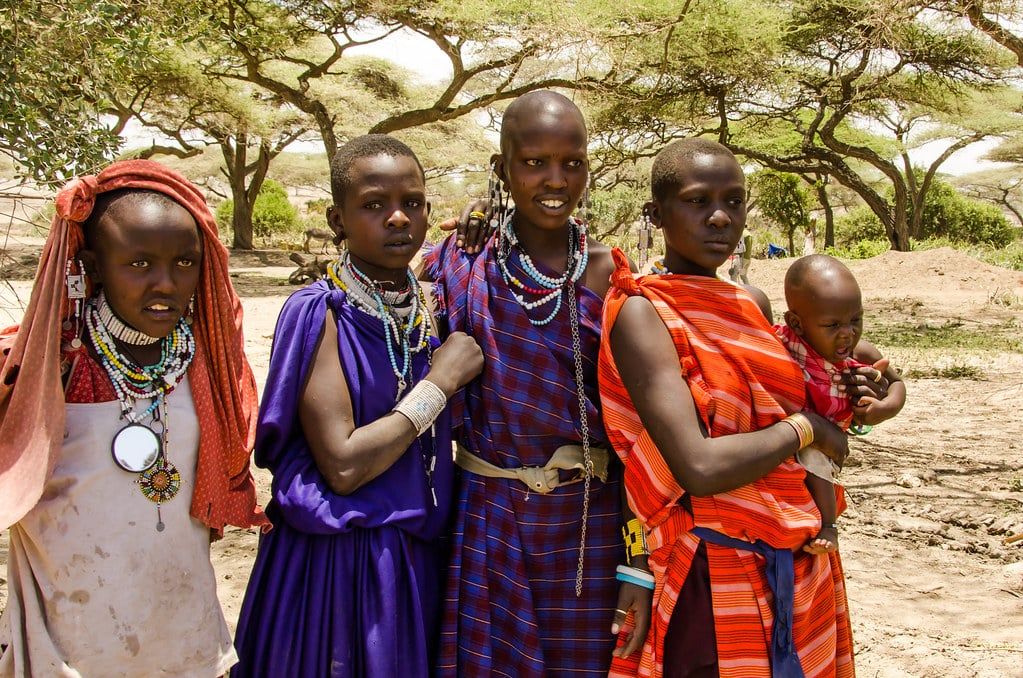
Maasai boma visits near the rim road — dances, homestead tours, craft markets — are widely sold, and many travellers value them. Go in with context: roughly 10,000 Maasai were relocated from the NCA between June 2022 and September 2024, and in December 2024 President Samia Suluhu Hassan publicly acknowledged past human rights violations and promised to address the land disputes. Ask before photographing anyone, and consider whether your visit compensates the community fairly.
Practical Tips: Packing, Health and Photography
You're dressing for two climates in one day: 0-5°C and mist on the rim at dawn, warm sun and wind on the floor by late morning. A fleece and windbreaker are the most-forgotten items on a northern Tanzania safari; add a warm hat for the gate queue. High-SPF sunscreen matters more than people expect — equatorial UV at 2,300 m, pouring through an open vehicle window, burns fast.
On health: malaria is present in the area even at altitude, so take prophylaxis and use repellent, and sort routine travel vaccines before you fly. Tsetse flies bite in the woodlands; they're drawn to black and dark blue, so wear neutral khaki-and-olive tones (camouflage prints, incidentally, are illegal for civilians in Tanzania). Sleeping-sickness risk is now much reduced by eradication efforts, but the bites still hurt.
Money is simple if you prepare: fees are paid by card or prepaid through your operator, but tips, village visits and small purchases need USD cash, and ATMs are scarce inside the conservation area — top up in Arusha or Karatu. Tanzania also bans plastic carrier bags nationwide, and airports inspect luggage for them.
For photography, leave the tripod: it doesn't work in a packed pop-top 4x4. A beanbag on the window sill does, timed between the vehicle's movement. A 300 mm-plus lens covers roadside lions; binoculars serve better for rhino on the far slopes. Shoot in the 6:30-8:30 window, carry spare batteries (cold rims eat them), and bring more SD card than you think you need — on a good morning, the frame count gets away from you. An insulated water bottle helps too, since fridges in safari vehicles are unreliable.
Frequently asked questions
Is one day enough for a Ngorongoro Crater safari?
For the crater floor, yes — one 5-6 hour game drive covers the highlights, and NCAA permits are valid for a single half-day entry. Extra nights in the area unlock Ndutu, Empakaai or Oldupai Gorge rather than more crater.
Can you see the Big Five in one day at Ngorongoro?
Four of five — lion, elephant, buffalo and black rhino — are realistic in a single morning. Leopard lives mainly in Lerai Forest in low numbers and is rarely seen, so treat it as a bonus.
Why are there no giraffes in Ngorongoro Crater?
The caldera walls are too steep for giraffes to descend, and the floor lacks the open woodland they need to feed. They're common in the wider conservation area and the Serengeti, which sit on your route anyway.
Is a Ngorongoro Crater safari worth the high fees?
For most travellers, yes. A couple pays roughly $437 in fees on a day trip, but no other park offers this density — 25,000 large animals in 260 km² — or black rhinos this reliably. Just expect a managed, time-limited drive rather than an open wilderness day.
What is the best month to visit Ngorongoro Crater?
June-October gives the best visibility but peak crowds. January-February is the sweet spot: green scenery, newborn animals, fewer vehicles and the Ndutu calving nearby. Mid-March to mid-May is lush and quiet but muddy.
Should I stay on the crater rim or in Karatu?
The rim gets you onto the floor around 6:30 am, 45-60 minutes ahead of Karatu traffic, at a price and concession-fee premium. Karatu is roughly an hour from the gate with cheaper, plentiful lodges. Rim camping at Simba A is the low-cost middle path.
Ngorongoro vs Serengeti — do I need both?
They're complementary. The crater delivers compact density and rhinos in one morning; the Serengeti delivers scale and the migration over multiple days. The standard Northern Circuit pairs both with Tarangire or Lake Manyara.
Can you self-drive Ngorongoro Crater?
Technically possible in the NCA, but the descent requires a permitted 4x4 with recovery gear and a licensed guide, and the $295 per-vehicle fee applies regardless. Once that's paid, self-drive saves little, and operators add radio intel on sightings — so nearly everyone goes guided.